Sweeping The Clouds Away
One day in my youth, when I was maybe eight or nine years old, I was lying on the living room floor, wrapped in my Aunt Jessie’s quilt (which was the best quilt in the whole world and actually made by my great aunt) watching Miss Marple work her magic in a drawing room in a country manor in a strange country I didn’t really understand, but desperately wanted to visit. I was waiting for the killer to be revealed when my dad walked through and said, “I can’t understand a goddamn word those people are saying!” I loved both that he couldn’t understand it and that I understood every single word.
This was the memory I was transported to a few weeks ago when I heard the news that the Corporation for Public Broadcasting was losing its funding from the Federal government. The loss of funding will mean the loss of both NPR and PBS. As an adult, I have listened to more National Public Radio than I have watched the Public Broadcasting System, but as a child, I don’t think it’s going too far to say PBS changed my life.
Thanks for reading Damn It, Suzy!! Subscribe for free to receive new posts and support my work.
Yesterday, I saw an Instagram reel of a young Jesse Jackson talking to children on Sesame Street with the caption, “What radicalized you?” He was telling them that no matter what they looked like or where they were from, they mattered. Watching it, I almost cried. I guess the right would call what Sesame Street did radicalization, but I would call it inspiration.
I grew up in a dysfunctional home, often without a lot of friends around. The TV, however, was always available. In those days, we didn’t have cable or internet, but we had ABC, CBS, NBC, one local channel that played old Godzilla movies, and PBS.
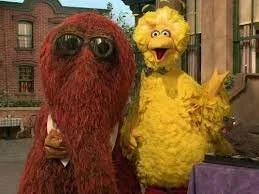
PBS became my jam as soon as I discovered it. It was a window into a lot of different worlds. There was, of course, Sesame Street, which was a daily fixture of my childhood. Big Bird and the gang were my pals and all I wanted was to live in a neighborhood where I could walk outside and see all of my friends, even the grumpy ones who lived in garbage cans. Those Muppets taught me about reading and writing and singing and feeling, all at a time when I wasn’t learning a lot of those things at home.
Snuffleupagus was my favorite. I loved the idea of having a giant invisible mastodon friend to protect me and I stole my own imaginary friends – Big Jennifer of the Jungle and Little Jennifer of the Jungle – from another PBS show, The Electric Company.
In addition to these two shows, I also regularly watched Zoom, The Letter People, Read All About It, and Mr Rogers. Jesus Christ, I loved Mr. Rogers. I mean, I know a lot of people did and do, but he was a salve to my anxious pre-K soul. The fact that my mother would walk by when he was on the TV and say, “Oh, there’s old gay Mr Rogers!” tells me a lot about what it meant to be a man in her generation. I didn’t know what “gay” meant to her, but I knew it wasn’t good. To her, though, I guess any man who was willing to come down to a child’s level by putting on a cardigan and tennis shoes and playing make believe, was less of a man. I strongly disagree. Fred Rogers, to me, was one of the greatest – and manliest – men of all time.
As I got older, I fell in love with Masterpiece Mystery, which is how I found myself wondering this week if I would have found two of my great loves – Agatha Christie and Edward Gorey – without PBS.
I remember the first time I turned on PBS and saw the animated Edward Gorey Masterpiece Mystery intro. I felt like I had stumbled upon something made just for me. It was thrilling. Maybe it was the mysteries, maybe it was the idea of people living in another country speaking an English not like my English, or maybe it was the beautiful outfits in the old English country manors, but I was enthralled and that first hit wasn’t enough. I quickly became a junkie.
The fact that my parents didn’t understand what I was watching on PBS made it even more appealing to me. These places and ideas were so far removed from the country house I grew up in in middle Tennessee, they might as well have been from outer space and I was the alien who had finally found my people.
So, yes, I am devastated about the loss of both NPR and PBS. I know Sesame Street is still streaming somewhere, but I’m pretty sure you have to pay for it. I never paid a dime for my Bert and Ernie fix. I just turned on the TV, adjusted the rabbit ears and settled in, ready to be transported somewhere the air was sweet.
I’m sure there is a lot of programming out there for children now, probably a lot more than there was when I was a child, but I don’t know how it could ever feel as magical as what I watched on PBS. It was the inability to pull it up whenever you wanted that made it feel more special.
Maybe the people who chose to defund the Corporation for Public Broadcasting never felt that magic. Maybe they didn’t need the lifeline I needed in that old country house full of ghosts and chaos. I don’t know what got them through the 70s, but whatever it was, it didn’t make them people who valued learning and curiosity and that, in itself, is sad to me.
I will be forever grateful to the people who produced those shows for probably way too little money for kids and adults like me who needed to know there was more out in the world than what they heard and saw and felt every day. They did sweep my clouds away and they helped me to imagine a better life when I desperately needed to.
In these trying times, I think it’s important to remember what Mr. Rogers said at the end of almost every episode:
“You always make each day a special day. You know how: By just your being you. There's only one person in the whole world that's like you, and that's you. And people can like you just the way you are.”
And if you’re not down with that, then I definitely don’t want to be your neighbor and you definitely can’t help me solve mysteries with my giant invisible mastodon.